The Gauntlet: how it works
The Gauntlet is a single-elimination tournament played on the season clock. Every rep is seeded into a bracket, the season splits into round windows, and each head-to-head is scored on that round’s window of points, both fighters from zero. Being the underdog on paper isn’t the end of it — the bracket hands every seed a named opponent and a round it can win.
01The board in one look
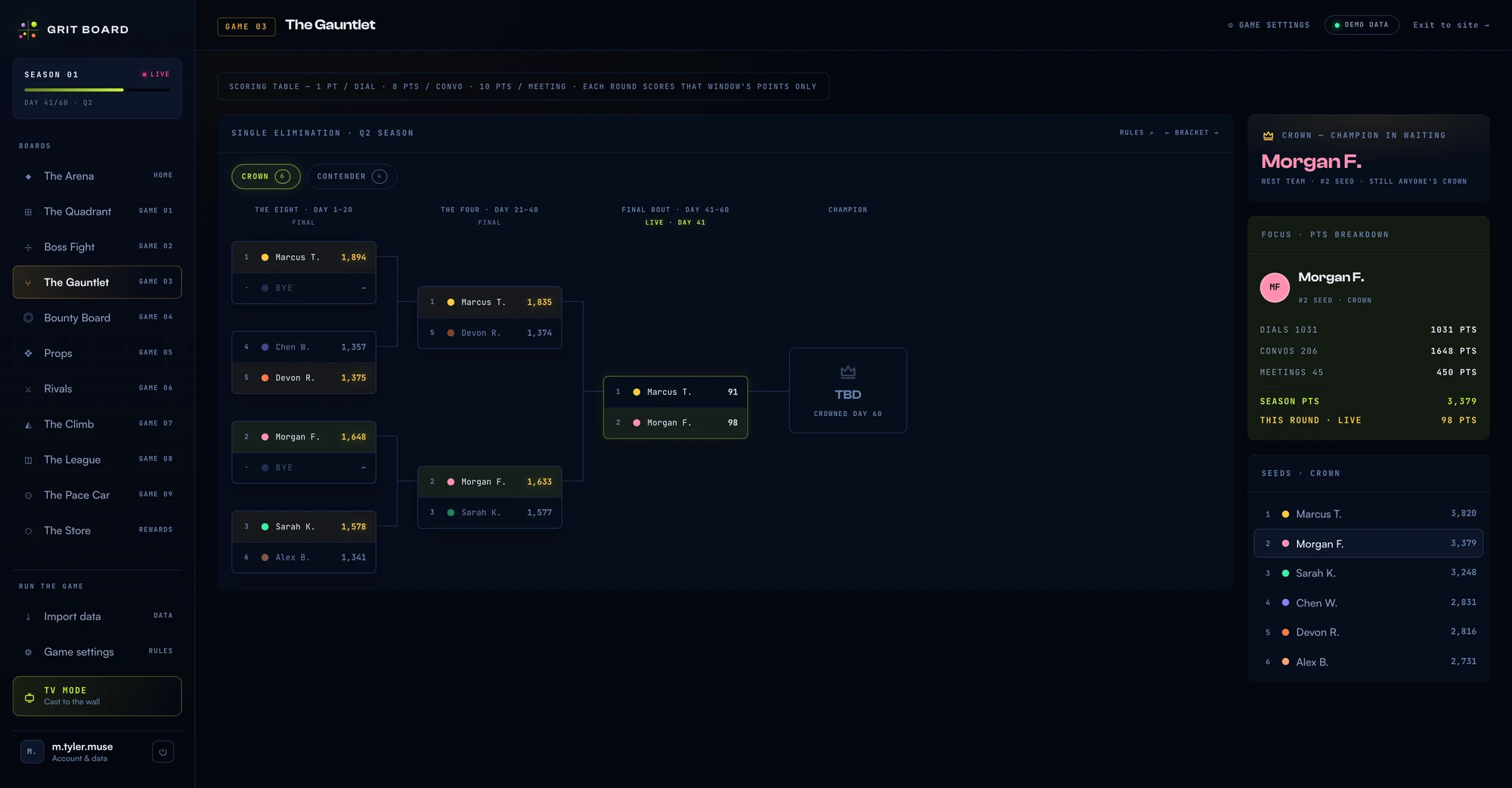
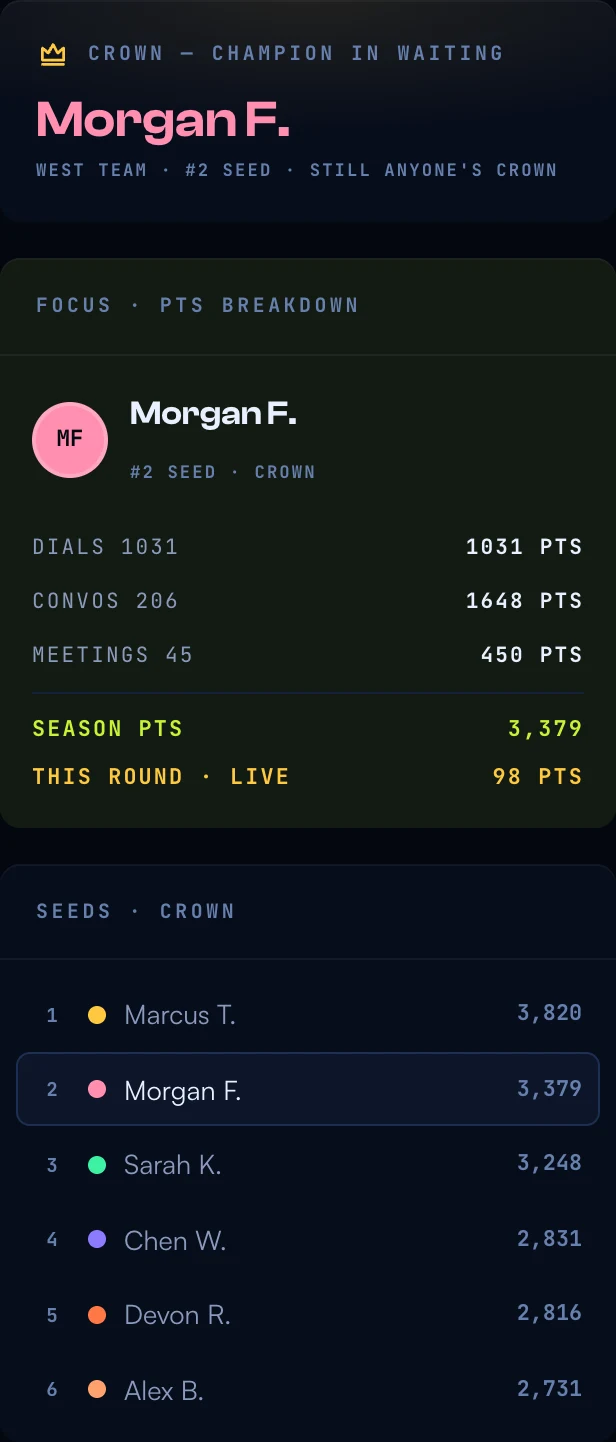
The bracket fills left to right as rounds close. On the right: the champion in waiting, a points breakdown for whichever player you select, and the seed list.
02How the bracket works
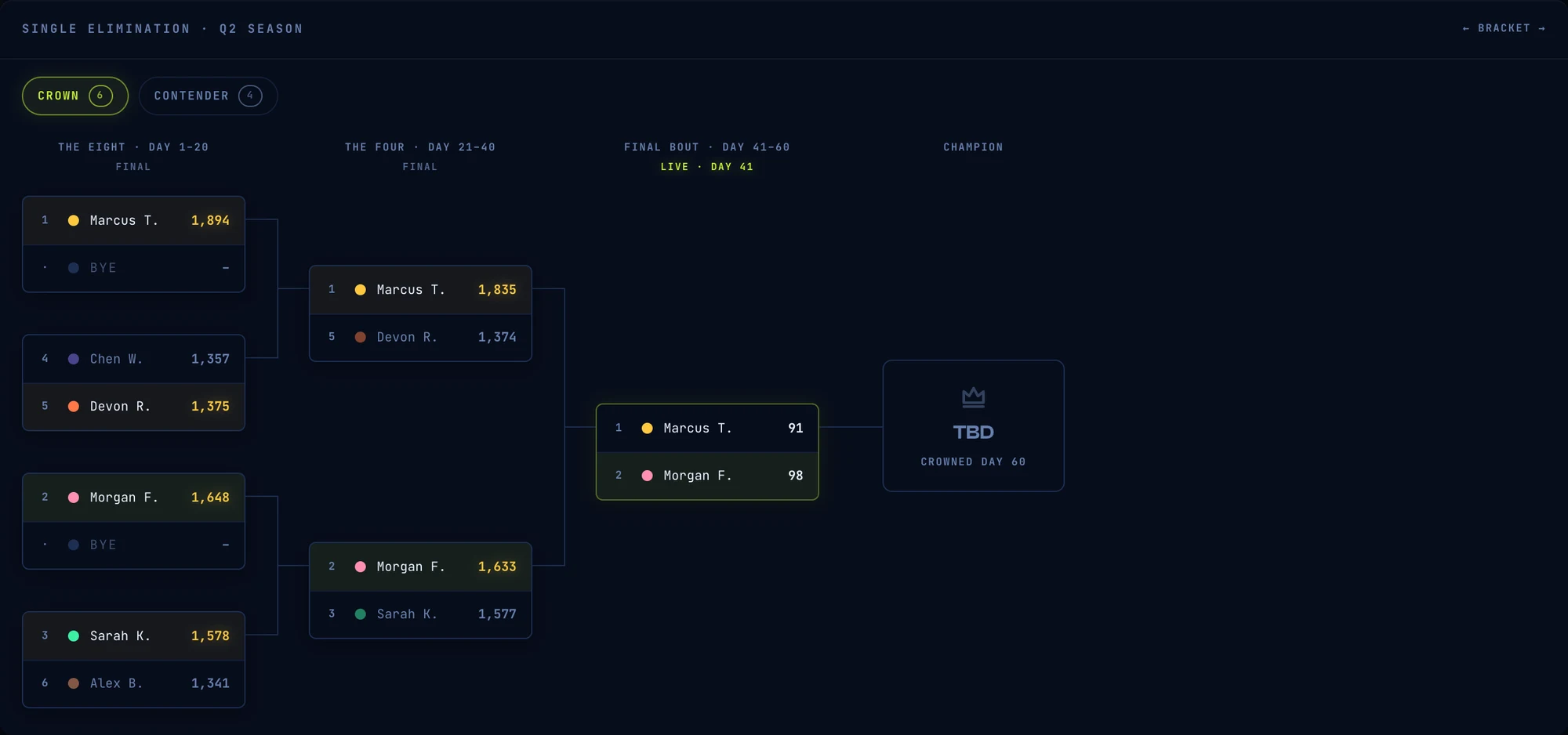
Seeding: players are ranked by season points and paired tournament-style — top seed meets the bottom seed, so the two best can only collide in the final.
Rounds are time windows. The season splits into equal windows — an 8-player bracket plays three rounds, a 4-player bracket two. A match is scored on that round’s window of points (the same weighted scoring table as the leaderboards, unless your manager picked a single metric — see setup). The current round shows live partial scores; a round decides itself the day its window closes. Nothing is ever a pre-decided reveal.
Where a round’s score comes from. Grit Board stores season totals, not day-by-day activity — so on your data, a round’s score is each fighter’s season total spread across the season’s days: an estimate of the window, not a diary of it. The board says so out loud — every estimated score wears a ~, and an Estimated note sits above the bracket. Winners, and the champion they roll up to, follow those estimates; the seeding, and the season totals underneath, are always real. (The screenshots on this page come from the built-in demo, whose whole season is sample data — that’s why its numbers carry no tilde.)
History is frozen. The moment a round closes, its result is written — scores, winner, and how it was won. Later data imports can’t rewrite a finished round.
03Everyone fights — the tiers
The Gauntlet never benches anyone. The top eight seeds fight for the CROWN; the next eight play the CONTENDER bracket, then CHALLENGER, and so on down the roster — every tier runs its own full bracket on the same round windows, and every tier crowns its own champion. This is deliberate: a classic leaderboard only motivates the people near the top, but seed #14 in a tiered bracket has a real, winnable matchup this window.
Odd roster sizes are handled with byes: a tier with five to seven players runs an 8-bracket and its top seeds skip round one. Brackets need at least four players to run.
04Ties, byes, and the champion
When a round ends dead even, the winner is decided by a chain the board always shows its work on: first the round metric, then total points earned in the same window, then the higher seed as a final deterministic backstop. A match card won on a tiebreak wears a TIE · PTS or TIE · SEED tag — an eliminated rep never has to guess why they’re out.
The champion is crowned only when the final’s window actually closes. Until then the board names a champion in waiting — the final’s live leader, or the best surviving seed — and says plainly that it’s still anyone’s crown.
05Setting it up (managers)
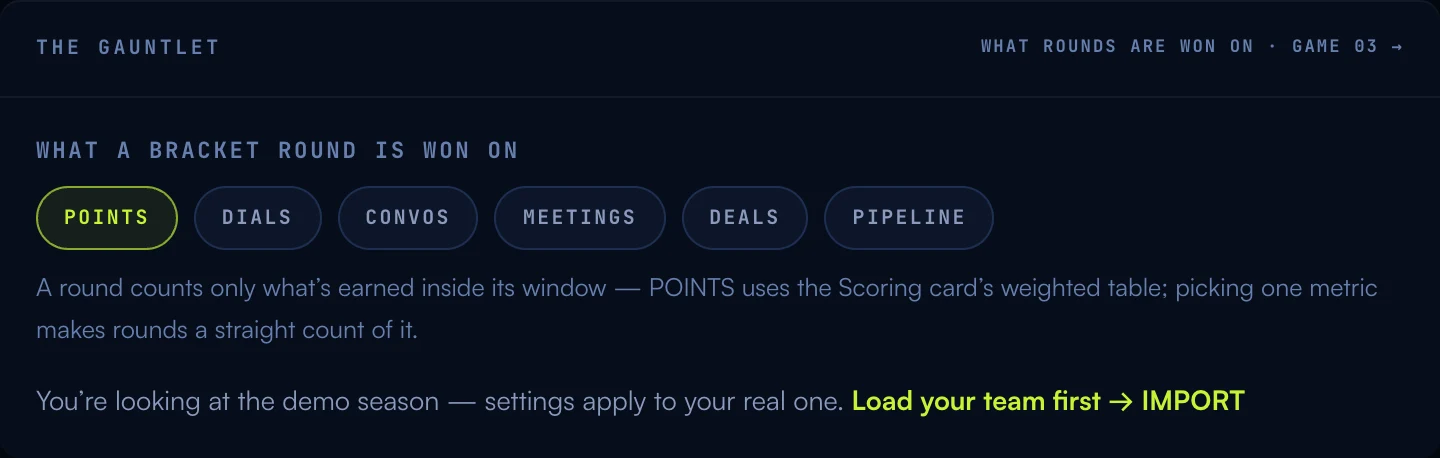
One decision: what a round is won on. The default is POINTS — the weighted scoring table, so the bracket rewards the same blend of work as the rest of the season. Or point it at a single metric (“the bracket runs on meetings”) and each round becomes a straight count of it. Seeding, windows, and tiers all take care of themselves.
06Common questions
“My opponent has way more season points — am I already out?” Not out — every match starts its window from zero, and season points only set the seeding. Fair warning, though: on your own data the window scores are estimated splits of season totals (see “Where a round’s score comes from”), so a rep with a big season lead usually leads the round too. The way to move your side of the score is the work you add from here on — every point you bank moves your split.
“Why did I advance without playing?” That’s a bye — your tier had an empty slot and it goes to the top seeds, the standard tournament rule. You’ll fight in the next round.
“When do rounds start and end?” The windows are printed above each bracket column (DAY 1–20, DAY 21–40…). A round closes on its last day and the winners advance immediately.
“Why do the round scores have a ~ in front?” Because they’re estimates — see “Where a round’s score comes from” in section 02. Grit Board doesn’t yet store your team’s day-by-day history, so it marks a window split as an estimate instead of pretending it’s a measurement.
More questions? Write to hello@gritboard.io — a human reads it. Curious what the game feels like? See the Gauntlet overview for the live demo.