Rivals: how it works
Rivals is the duel game. Every week of the season, every rep is automatically paired against one named opponent at their own level, and the duel is scored on that week’s window of points. Win and your rating climbs; the ladder re-pairs, and next week’s fight is a little harder. It’s the board built on a simple truth: a race against the #1 rep motivates almost nobody — a coin-flip fight against your actual rival motivates everyone.
01The board in one look

Top left: this week’s duels, live. Below them: next week’s pairings, already known, and the history of closed weeks. Right: the ladder — the roster ranked by rating.
02How a duel works
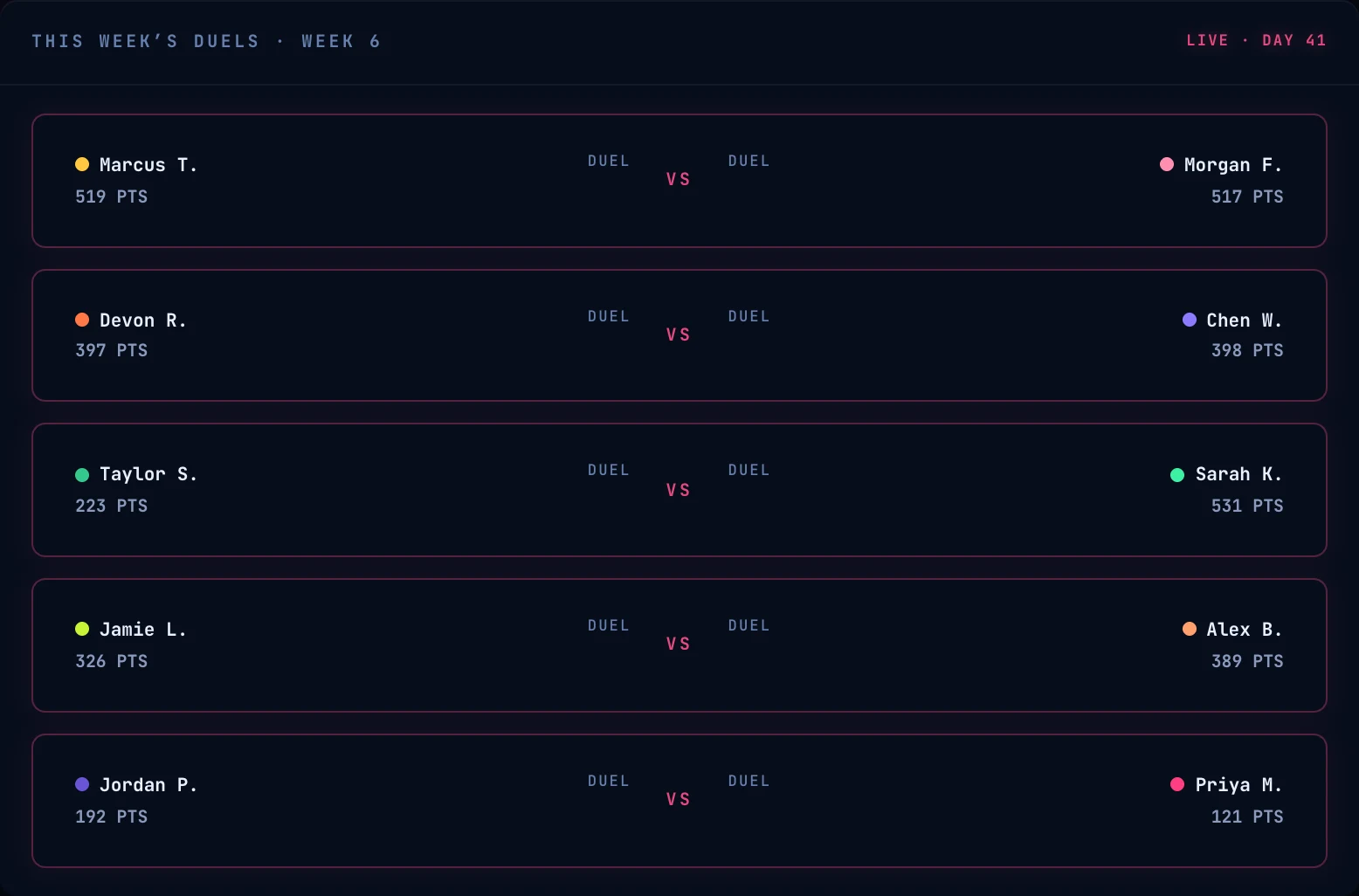
A Rivals week is seven season days. Your duel is scored on that week’s window of points — the same weighted scoring table as the rest of the season, both fighters starting the window from zero. The board shows live provisional scores all week; the duel decides itself when the week closes. An exact tie is a draw.
Where the weekly score comes from. Grit Board stores season totals, not day-by-day activity — so on your data, a duel’s weekly points are each fighter’s season total spread across the season’s days: an estimate of the week, not a diary of it. The board says so out loud — every estimated score wears a ~, and the panel carries an Estimated note. Winners and rating moves follow those estimates; the pairings, and the season totals underneath, are always real. (The screenshots on this page come from the built-in demo, whose whole season is sample data — that’s why its numbers carry no tilde.)
Both fighters can always see the score, which is the point: a duel that’s 519 to 517 on a Thursday is worth one more call on Friday.
03The ladder — how ratings move
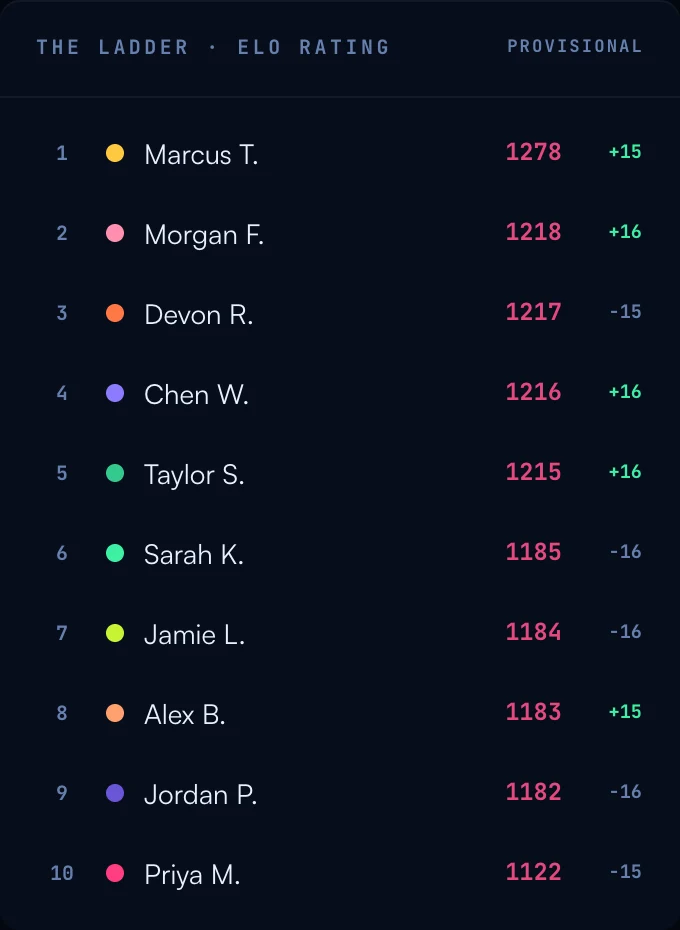
Everyone starts at a rating of 1200. Win a duel and you take rating points from your opponent; lose and you give some up. The amounts follow the classic chess (Elo) formula: beating a higher-rated fighter pays big, losing to one costs little — so an upset actually moves the ladder, and a favorite grinding out expected wins climbs slowly. Ratings never fall below a floor, so nobody gets buried out of fightable range.
The ± column shows each fighter’s change from the last completed week — not the live duel. While a week is underway the ladder is marked PROVISIONAL — ratings only actually move when a week closes. On your own data the badge reads ESTIMATED instead: your ratings are the replay of weekly duels scored on estimated splits (see “Where the weekly score comes from” above), and the ladder says so rather than dressing them up as measured weeks.
04How pairings are made
Each week the roster is sorted by rating and paired top-down — 1st versus 2nd, 3rd versus 4th, and so on. That’s the whole trick: close ratings, close fights. Two extra rules keep it fair:
- Rematch dodge. If a pairing would repeat last week’s opponent, the board swaps with the next pair down when that fixes it. If a rematch survives anyway, it stands — that’s a grudge match, and those are fine.
- Byes on odd rosters. With an odd number of reps, the lowest-rated fighter sits the week out. A bye is a rest, never a win — no points, no rating change.
05History is written once
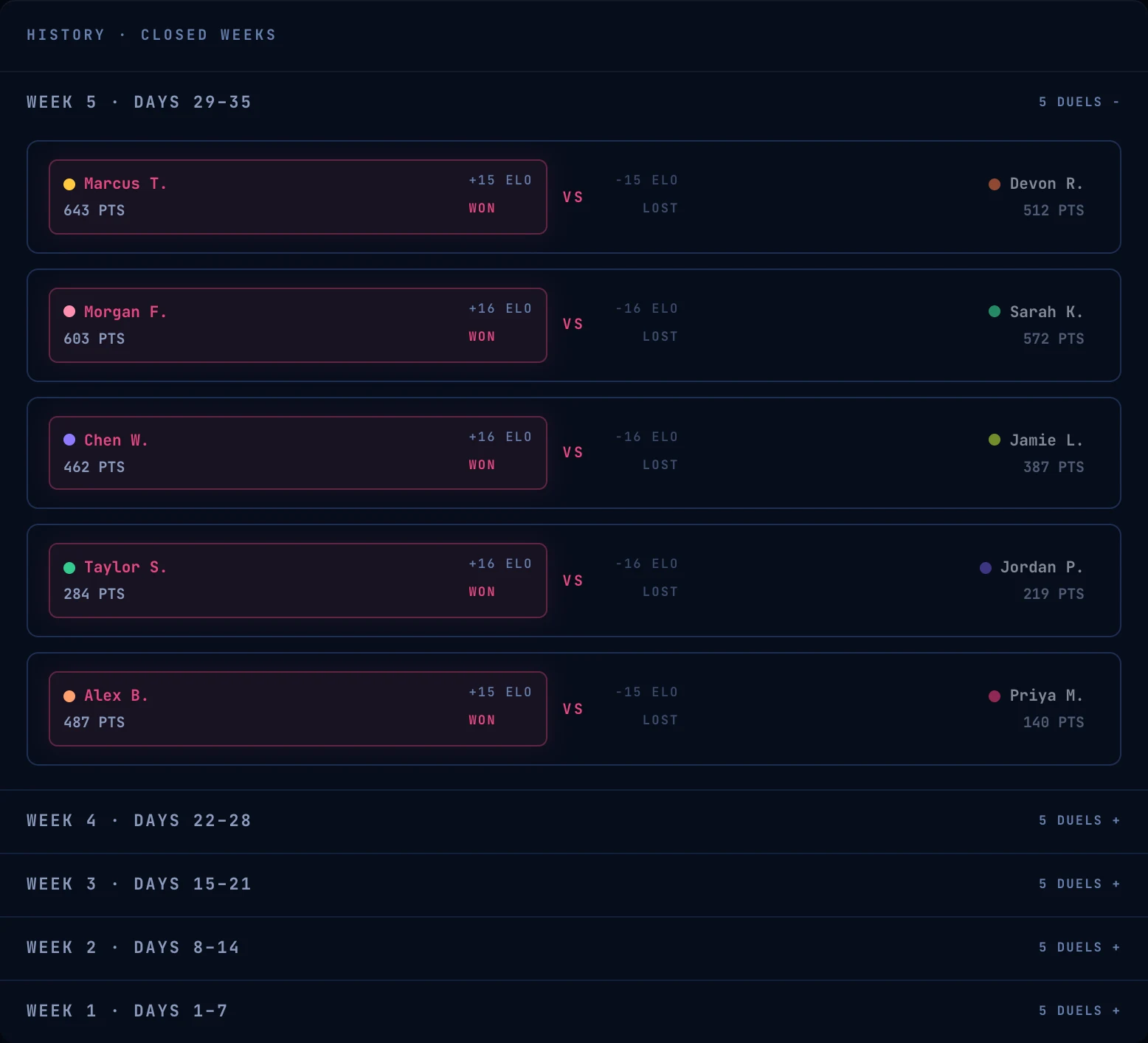
When a week closes, its results are frozen — final scores, the winner, and both rating changes. Later data imports can’t rewrite a finished duel, and a rep who later leaves the roster keeps their place in the record. Your current rating is always just the replay of that history: no hidden adjustments, ever.
06Setup and common questions
There’s nothing to configure. Rivals pairs itself from the roster and scores duels with the season’s scoring weights (set once in Game settings — see The Quadrant doc for how those work). It needs at least two players.
“Why do I keep fighting the same few people?” Because your ratings are close — that’s the system working. Win a couple and you’ll climb into a new bracket of opponents.
“I have fewer season points than someone below me on the ladder — how?” The ladder doesn’t rank totals; it ranks duel results. Winning your weekly fights — whoever you are — is what climbs it. It’s the one board where a mid-roster rep who shows up every single week can outrank a streaky top seller.
“What happens on a draw?” Dead-even weeks happen. Ratings barely move — the higher-rated fighter gives up a couple of points, and that’s it.
“Why do the duel scores have a ~ in front?” Because they’re estimates — see “Where the weekly score comes from” in section 02. Grit Board doesn’t yet store your team’s day-by-day history, so it marks a weekly split as an estimate instead of pretending it’s a measurement.
More questions? Write to hello@gritboard.io — a human reads it. Curious what the game feels like? See the Rivals overview.